
Nimora
Industry playbook

Nimora for Jewelry & Accessories.

Make small product details easier to sell with sharper imagery, clearer metadata, and stronger campaign pages.

Best for visual catalogs where close-up confidence matters.

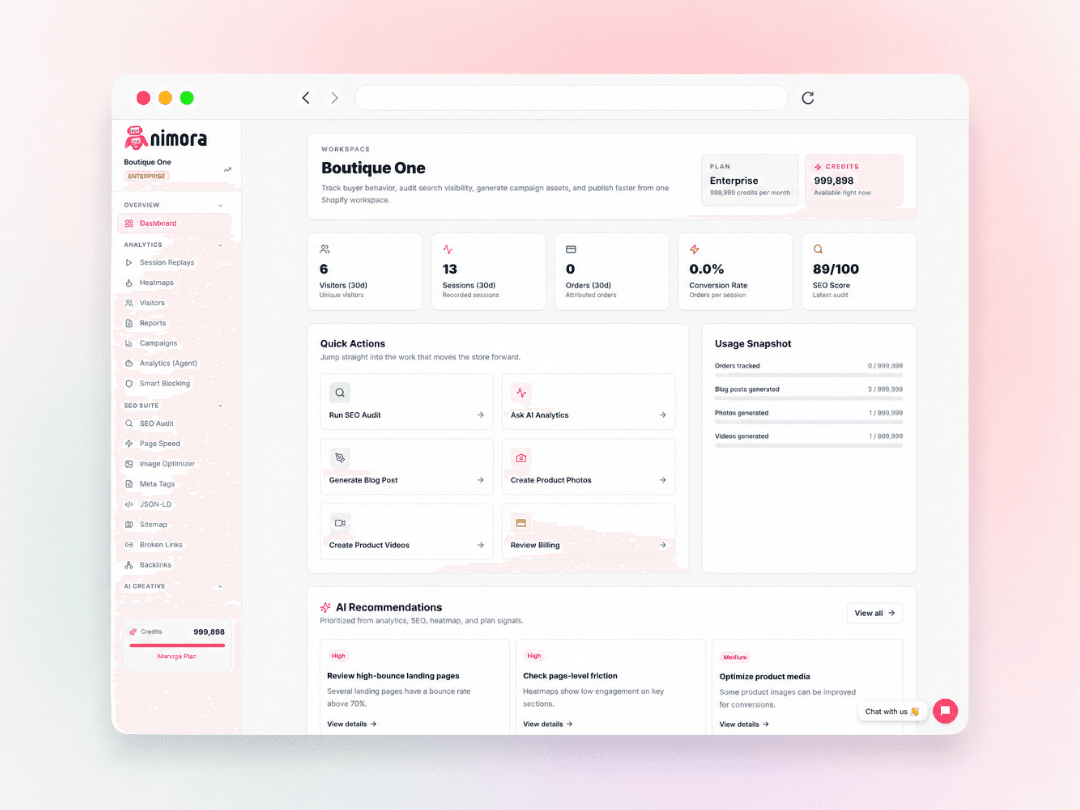
Nimora ecommerce workspace for Jewelry & Accessories

SEO

Clean metadata, schema, sitemap, image alt text, and broken link issues before they compound.

Media

Create product photos, product videos, and campaign assets that match live catalog context.

Insight

Use replays, heatmaps, visitors, campaigns, and reports to decide what to fix next.

What to focus on first

Build the weekly rhythm around the work that actually moves conversion.

Macro-style visuals

Collection SEO

Campaign landing paths

Industry command center

Jewelry & Accessories workspace

Priority signals

Search visibility

SEO fixes queued

Product confidence

New media drafts ready

Buyer hesitation

Replay friction detected

Recommended first move

Audit the highest-traffic product page, improve one weak asset, and review visitor friction before the next campaign.

SEO review

Metadata, alt text, structured data, sitemap, and broken links.

Creative pass

Product photos, launch visuals, and short-form video ideas.

Revenue context

Campaigns, orders, buyers, visitors, and page-level friction.

Approval queue

Review changes before they publish to the connected store.

Enterprise operating view

Give every team the same read on what needs attention.

Jewelry & Accessories stores usually have too many separate signals: SEO tools, creative requests, analytics reports, campaign notes, and product feedback. Nimora turns those signals into a single weekly operating view for deciding what to fix, create, and publish next.

Prioritize pages and products before creating more work.
Tie creative output back to catalog context and campaign needs.
Keep approvals visible so teams can move quickly without losing control.

Industry growth system

Make every jewelry & accessories workflow support the next buying decision.

Nimora is strongest when SEO cleanup, visitor insight, product media, content, and campaign reporting all point toward the same store outcome.

Prioritize Jewelry & Accessories pages by traffic quality, product importance, and visible shopper friction.

Create product media and content from live catalog context instead of disconnected prompts.

Keep SEO fixes, visitor behavior, campaign reporting, and review steps in one operating flow.

Use approved changes and revenue context to decide which workflow should repeat next week.

Industry context

Jewelry & Accessories teams need workflows that keep pace with real buying behavior.

Jewelry & Accessories stores usually have more moving parts than a simple catalog suggests. Products change, campaigns shift, seasonal demand appears quickly, and shoppers compare details before committing. Nimora gives these teams a practical way to keep SEO, visitor insight, product media, content, and reporting close to the same store context. That means the team can improve a page while understanding the traffic and buyer behavior around it.

The best growth work for Jewelry & Accessories does not come from isolated metrics. It comes from connecting the page, the product, the campaign, and the shopper question. Nimora helps merchants see where the store needs attention, create stronger assets, clean up search visibility, and keep the final review in one workspace. The result is a workflow that supports daily execution instead of another dashboard that only explains yesterday's problem.

Operating rhythm

Build the week around the work that matters most: Macro-style visuals, Collection SEO, Campaign landing paths.

A practical weekly rhythm starts with priority. Which products are getting traffic? Which pages are ranking but not converting? Which campaigns are sending visitors who hesitate? Which products need better visual proof before the next launch? Nimora helps Jewelry & Accessories operators turn those questions into a focused list of tasks, then gives them the tools to move from diagnosis to approved improvement.

This rhythm is important because store teams can burn hours on low-value cleanup. A better approach is to look for the work that improves both discovery and confidence. Run the audit, inspect the buyer journey, improve the product asset or page content, publish only after review, and then watch the next result. That repeatable loop makes growth work easier to manage and easier to explain to the team.

Conversion strategy

High-converting pages answer the question behind the click.

A visitor who lands on a Jewelry & Accessories product page is usually trying to reduce uncertainty. They want to know whether the product fits the need, whether the store can be trusted, whether the details are clear, and whether buying now is worth it. Nimora supports that buying moment by helping teams improve metadata, product visuals, page content, campaign alignment, and visitor friction from one place.

That is why the workflow is broader than a single feature. SEO brings qualified discovery. Replays and heatmaps reveal hesitation. AI product creative adds proof and context. Blog and page content explain the product more clearly. Campaign reporting shows whether the traffic deserves more budget. When those pieces are connected, the store can improve the buying path instead of guessing which surface matters.

Content and creative

Product assets should make the offer easier to believe.

Jewelry & Accessories shoppers respond to proof. They need images, short videos, product explanations, benefit-led copy, and trust signals that match the page promise. Nimora can help create product-led assets from real catalog context so the team is not starting from a blank prompt or generic creative brief. The output can support product pages, social posts, launch campaigns, and content that answers buyer questions.

The strongest creative is not just attractive. It helps the shopper understand use, fit, quality, outcome, or comparison. Nimora keeps that creative work close to page data and visitor behavior, so the team can see which products need better support and which assets should be reviewed before the next push. That connection makes creative production more accountable to store performance.

SEO foundation

Search cleanup should support the same products the team is trying to sell.

SEO work becomes more valuable when it is tied to revenue priorities. Missing titles, weak descriptions, image alt gaps, broken links, sitemap issues, and structured data problems can quietly weaken visibility across a catalog. Nimora helps Jewelry & Accessories teams group those issues, review the safe fixes, and keep cleanup connected to the products and collections that matter most.

This avoids the common trap of treating SEO as a disconnected checklist. A product page should be discoverable, understandable, persuasive, and easy to evaluate. When SEO repair sits beside visitor insight and product creative, the store can improve the full buying path rather than only changing metadata. That is the difference between cleanup work and sales-supporting execution.

Team adoption

The workflow is built for operators, agencies, and owners who need visible control.

A useful growth platform has to fit the way ecommerce teams actually work. Owners want clarity. Operators want speed. Agencies need proof for clients. Content and creative teams need context. Nimora keeps the queue, the evidence, and the review step visible so each role can understand what is being changed and why it matters.

That visible control is especially important for Jewelry & Accessories stores with frequent launches or fast catalog changes. The team can start with a narrow workflow, prove the value, then expand into broader SEO, analytics, media, and content operations. The system is designed to make the next action easier without forcing the team into a complicated new process.

Creative that keeps pace

Product content should move as fast as your catalog.

Nimora helps teams turn product context into social-ready visuals, product videos, and campaign creative while the page data and shopper signals stay nearby.

Denim launch

10s product creative

Eyewear reveal

10s product creative

Skincare drop

5s product creative

Supplement brand

15s product creative

Denim launch

10s product creative

Eyewear reveal

10s product creative

Skincare drop

5s product creative

Supplement brand

15s product creative

Denim launch

10s product creative

Eyewear reveal

10s product creative

Skincare drop

5s product creative

Supplement brand

15s product creative

UGC unboxing

15s product creative

Ad-ready reel

10s product creative

Wholesale hero

10s product creative

SaaS explainer

5s product creative

UGC unboxing

15s product creative

Ad-ready reel

10s product creative

Wholesale hero

10s product creative

SaaS explainer

5s product creative

UGC unboxing

15s product creative

Ad-ready reel

10s product creative

Wholesale hero

10s product creative

SaaS explainer

5s product creative

How the loop works

Every workflow should move toward a better store page.

Nimora keeps the practical pieces close together: find the weak page, understand the shopper behavior, create the missing asset, approve the change, and watch the next result.

Audit the page

Find SEO, speed, content, and structured-data gaps around the products that matter.

Understand the behavior

Use visitors, campaigns, heatmaps, and replays to see where shoppers hesitate.

Create stronger assets

Generate product photos, videos, and content from actual catalog context.

Review before publish

Keep the final decision visible before updates reach the storefront.

FAQ

Questions before you connect a store.

Is Nimora useful for Jewelry & Accessories stores that already have analytics?

Yes. Nimora is designed around the work that happens after a metric changes: replay the shopper path, inspect SEO gaps, create stronger product media, and review what should be fixed next.

Can my team review changes before anything goes live?

Yes. Nimora keeps generated media, SEO updates, and content work visible before publish so operators can approve the right output instead of pushing blind changes.

What should we try first?

Most Jewelry & Accessories teams start with one of three workflows: run an SEO audit, review visitor friction on key product pages, or generate better media for a high-priority product.

Does this work for more than Shopify?

Shopify is the fastest install path. Nimora also supports WooCommerce through the WordPress plugin and Wix through the current store connection flow.

What should a Jewelry & Accessories store try first?

Start with one high-value product page, collection, or campaign path. Run the audit, review visitor behavior, improve the page or asset that is most likely to affect buying confidence, and measure what changes after the update.

Is Nimora only for large teams?

No. Smaller Jewelry & Accessories teams can use Nimora to reduce tool switching and get faster first value. Larger teams can use the same workspace to create a repeatable rhythm for SEO, analytics, creative, content, and reporting.

How does Nimora support better creative decisions?

The AI media workflows can start from live product context, while analytics and visitor behavior show where clearer product proof may be needed. That keeps creative work tied to actual store needs instead of disconnected brainstorming.

How does this help with paid campaigns?

Nimora helps teams compare campaign quality, landing page behavior, product-page readiness, and revenue outcomes. That makes it easier to decide whether to improve the page, change the asset, adjust the offer, or stop sending traffic to a weak path.

Start with one store workflow

Connect Nimora and find the next page worth improving.

Install Free